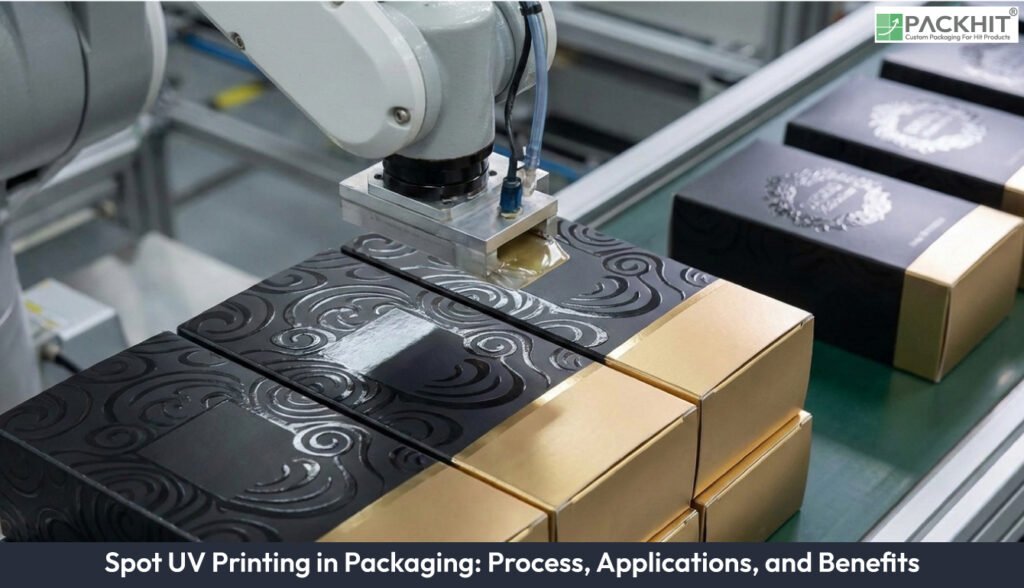
Spot UV printing in packaging applies a clear UV‑cured varnish to selected print zones to create defined gloss contrast on cartons, sleeves, envelopes, and cards. The process of spot UV printing in packaging covers artwork separation, colour‑layer printing, selective varnish deposition, UV curing, and final sheet checks that stabilise gloss and film hardness. Spot UV printing in packaging formats is used for brand marks, pattern blocks, photographic areas, directional cues, security marks, and raised detail across cosmetic cartons, business cards, envelopes, small‑format wraps, and inserts. Benefits of spot UV printing in packaging include strong visual contrast, raised tactile points, fast UV cure, VOC‑free varnish chemistry, abrasion resistance on contact zones, and accurate feature control on short batches. Spot UV printing in packaging production relies on substrate holdout, varnish‑film thickness, registration alignment, cure balance, and de‑inking compatibility. Limitations of spot UV printing in packaging relate to substrate absorption, folding stress, tight registration, exposure demands, cost of thick films, halftone loss on soft gradients, and fibre‑porosity shifts on recycled boards. Spot UV workflows trend toward faster deposition speeds, controlled low‑VOC formulations, and precise application on UK packaging runs where sharp gloss boundaries guide consumer focus.
- What is Spot UV Printing in Packaging?
- What is the Process of Spot UV Printing in Packaging?
- 1.Artwork Preparation and Varnish Separation
- 2. Substrate Printing with Defined Colour Layers
- 3. Varnish Application Through Screen, Plate or Digital Unit
- 4. UV Exposure and Curing
- 5. Sheet Handling, Drying Balance, and Quality Checks
- What are the Applications of Spot UV Printing in Packaging?
- Folding Carton Packaging
- Envelopes
- Business Cards
- Sleeves and Small-format Wraps
- Promotional and Launch Packaging
- Brand Documentation and Inserts
- What are the Benefits of Spot UV Printing in Packaging?
- Improved Visual Focus
- Tactile Definition On Key Panels
- Fast, Controlled Curing
- Solvent‑Free Chemistry
- Localised Surface Protection
- Accurate Feature Control On Short Runs
- What are the Key Design and Technical Considerations for Spot UV Printing in Packaging?
- What are the Limitations of Spot UV Printing in Packaging?
- Why Choose Spot UV Printing in Packaging?
What is Spot UV Printing in Packaging?
Spot UV printing in packaging refers to the application of a clear, ultraviolet-cured varnish to selected areas of printed packaging to create a high-gloss contrast. The process uses a fast-curing varnish that forms a hard, smooth film with precise edge control. This method adds defined visual accents and localised protection to cartons, sleeves, and other printed substrates. Common examples include folding cartons for cosmetics, envelopes with selective gloss, and business cards with raised focal points.
What is the Process of Spot UV Printing in Packaging?
The process of spot UV printing in packaging applies a UV‑cured varnish to selected artwork zones through a controlled, multi‑stage production sequence that fixes gloss, texture, and edge definition onto the printed substrate.
- Artwork Preparation and Varnish Separation
- Substrate Printing with Defined Colour Layers
- Varnish Application Through Screen, Plate or Digital Unit
- UV Exposure and Curing
- Sheet Handling, Drying Balance, and Quality Checks
1.Artwork Preparation and Varnish Separation
Artwork preparation and varnish separation start with a dedicated spot‑varnish channel that isolates every gloss target zone. This separation assigns a single varnish colour swatch, set to overprint, so production equipment reads it as a coating area rather than an ink layer. Designers exclude fold lines, glue flaps and perforations at this stage because varnish builds cracks across creases and block adhesive. Small features below roughly 0.3 mm lose shape after curing, so artwork holds minimum widths. Context‑specific files for folding cartons, envelopes or business cards include dielines, score marks and any substrate notes.
2. Substrate Printing with Defined Colour Layers
Substrate printing with defined colour layers lays down CMYK or spot inks before varnish touches the sheet. The print pass depends on the board or paper type used for folding cartons, envelopes or cards. Colour density, trapping and the smoothness of coated stock influence gloss perception once varnish sits on top. Print teams avoid low‑contrast halftones under varnish if gloss may hide fine tone detail. Registration marks appear on each sheet so the varnish unit can align with the printed panel.
3. Varnish Application Through Screen, Plate or Digital Unit
Varnish application through screen, plate or digital unit deposits a measured varnish film only where the artwork channel indicates. Screen units deposit a thicker layer used for raised relief. Litho plates lay down thinner films for smooth gloss accents on folding cartons. Digital varnish heads apply variable thickness for short‑run packaging or personalisation jobs, for example, serialised marks on sleeves. Varnish contains acrylate chemistry and photoinitiators that react during UV exposure, so uniform coverage and correct film height avoid pinholes or ridged edges.
4. UV Exposure and Curing
UV exposure and curing fix the varnish into a hard film. Lamps emit controlled wavelengths that activate the photoinitiator package, forming a crosslinked surface. LED‑UV systems run at cooler temperatures and reduce sheet warp on lighter boards. Curing speed depends on film thickness: raised builds require longer exposure than flat coats. A complete cure stops rub‑off on high‑contact areas and prevents blocking during stacking.
5. Sheet Handling, Drying Balance, and Quality Checks
Sheet handling, drying balance, and quality checks assess gloss uniformity, registration accuracy, and surface hardness. Operators check gloss contrast between varnished and unvarnished areas and confirm that raised details keep their shape without collapse. Packaging destined for food‑adjacent applications uses compliant varnish grades, and jobs involving recycled fibres undergo additional de‑inking tests. Stable stacks avoid pressure marks while the varnish settles. Final inspection verifies that folding zones remain free of cracking and that contact points on cartons, envelopes, or cards hold abrasion resistance.
What are the Applications of Spot UV Printing in Packaging?
The applications of spot UV printing in packaging concentrate on selective gloss and raised varnish that draw visual focus, add tactile cues, and strengthen key print zones on cartons, sleeves, envelopes, and cards.
Folding Carton Packaging
Folding carton packaging uses spot UV varnish to isolate brand marks, pattern blocks, or photographic areas that need strong gloss contrast. This method sharpens colour density on coated boards and adds a tactile ridge if a raised film is deposited. Cosmetic boxes, gift cartons, and small rigid sleeves often rely on these accents to guide consumer attention across a shelf panel.
Envelopes
Envelopes use spot UV to mark logos, address blocks or message panels with precise gloss differentials that stand out against an uncoated or satin background. The varnish creates clean edges on flat substrate areas and holds up to common postal friction if the film is fully cured. Short business runs and mailer campaigns often apply digital spot units when variable text or changing artwork appears.
Business Cards
Business cards use spot UV to isolate names, symbols or geometric panels with a controlled gloss that increases colour depth on mid‑tone backgrounds. Raised coatings add grip points that assist handling and create a noticeable three‑dimensional form on thicker stocks. High-density coated cards support sharp varnish boundaries without haloing.
Sleeves and Small-format Wraps
Sleeves and small-format wraps use spot UV to break up matte surfaces with directional gloss zones. The varnish indicates product cues such as flavour blocks, security marks or image contours. Short-run items gain from digital units that place the varnish without screens or plates.
Promotional and Launch Packaging
Promotional and launch packaging uses spot UV to raise focal motifs during seasonal or limited-edition runs. The varnish adds a clear film that strengthens rub resistance on header areas exposed to repeated touch in retail setups. Limited runs favour digital deposition where artwork cycles frequently.
Brand Documentation and Inserts
Brand documentation and inserts use spot UV on logos, section headers, or icon sets to create contrast against unvarnished fields. The varnish builds a sharp edge on coated sheets used for product manuals or warranty cards and withstands handling without colour shift because the varnish layer is clear.
What are the Benefits of Spot UV Printing in Packaging?
Benefits of spot UV printing in packaging centre on controlled gloss contrast, tactile variation, fast curing, and solvent‑free chemistry that supports production efficiency and visual clarity on folding cartons, sleeves, envelopes, and cards.
Improved Visual Focus
Improved visual focus results from the sharp gloss boundary that spot UV creates on selected artwork zones. The varnish adds a reflective film that increases colour density on coated boards and isolates logos, pattern blocks or photographic areas. This contrast directs attention to shelf panels used in UK retail settings where crowded categories rely on precise visual hierarchy.
Tactile Definition On Key Panels
Tactile definition on key panels arises when the varnish forms a raised film through a controlled screen or digital deposition. Raised zones add grip points that guide handling on rigid sleeves, folding cartons or business cards. The increased film height preserves edge shape after UV cure and builds a three‑dimensional cue that supports product positioning in premium categories.
Fast, Controlled Curing
Fast, controlled curing occurs because UV varnish polymerises within a short exposure window. The quick reaction decreases sheet turnaround time and stabilises gloss uniformity before downstream finishing. LED‑UV units lower thermal load on lightweight board grades and reduce the risk of warp during multi‑pass work.
Solvent‑Free Chemistry
Solvent‑free chemistry describes the UV varnish formulation that omits VOCs and avoids harmful solvent residues. Cured films remain inert and suit packaging workflows where emissions targets apply. This chemistry supports UK printers that follow controlled air‑quality standards and prefer low‑emission coating systems.
Localised Surface Protection
Localised surface protection results from the varnish film that resists abrasion on header areas, panel edges or contact points. The cured layer reduces rub‑off on printed colour zones that encounter repeated touch, especially on high‑handling cartons or mailer envelopes. Raised or flat films protect colour solids without masking tonal information.
Accurate Feature Control On Short Runs
Accurate feature control on short runs emerges when digital spot units place varnish with variable thickness or variable data. This approach suits personalised sleeves, promotional batches or serialised marks on limited‑edition packs. The process removes the plate or screen setup and keeps the detail integrity on small geometric shapes.
What are the Key Design and Technical Considerations for Spot UV Printing in Packaging?
Spot UV printing in packaging depends on artwork layout, substrate behaviour, and varnish‑film control. These factors guide gloss placement, tactile height, and registration accuracy during production.
- Artwork layout: restrict varnish zones to flat faces; exclude folds, glue tabs, and perforations; apply a separate spot‑varnish channel with clear naming.
- Substrate behaviour: assess coated boards, uncoated fibre, or PET films. For example, folding boxboard at 300–400 gsm; smooth surfaces hold sharper varnish edges.
- Varnish‑film control: define thickness for gloss or raised forms; screen units deposit thicker layers; digital units place variable data for short runs.
- Drying and handling: confirm full UV cure to avoid blocking; maintain stack spacing to protect heavy varnish builds.
- Environmental limits: use varnish grades without VOCs; select de‑ink‑compatible coatings, if recycled‑fibre recovery is required.
These considerations stabilise gloss contrast on cartons, sleeves, and cards when production demands precise spot UV placement.
What are the Limitations of Spot UV Printing in Packaging?
The limitations of spot UV printing in packaging relate to substrate behaviour, layout constraints, curing demands, production cost on complex builds, and registration sensitivity across folding cartons, sleeves, envelopes, and cards.
- Substrate limits: Coated boards hold sharp varnish edges. For example, GC1 or SBS grades, while uncoated fibres absorb varnish and reduce gloss contrast.
- Folding constraints: Creases, glue tabs, and perforations reject varnish; cracking appears if varnish crosses a score on cartons or sleeves.
- Registration tolerance: Misalignment between print and varnish appears on small shapes. For example, micro‑icons or thin pattern bars.
- Cure sensitivity: Thick films require longer UV exposure; incomplete cure causes blocking in stacks or surface tack on mailer envelopes.
- Cost variance: Raised films require screen units or digital relief heads; extra varnish weight increases cycle time on short commercial runs.
- Texture limits: Varnish hides halftone detail if placed on low‑contrast colour zones. For example, soft gradients on cosmetics cartons.
- Surface holdout: Recycled substrates show variable fibre density; pinholes form in varnish films if surface porosity shifts sheet‑to‑sheet.
Why Choose Spot UV Printing in Packaging?
Choose Spot UV printing in packaging because it adds concentrated gloss contrast to logos or pattern blocks and increases the definition of small features on cartons or sleeves. The varnish uses solvent‑free chemistry that avoids VOCs and supports UK printers that follow emission controls. Fast curing shortens handling time on commercial runs, and selective placement suits folding cartons, envelopes, or business cards that require precise focal accents.